

We get it. Between early morning workouts, client presentations, and trying to keep your weekly meal prep on track, managing a busy schedule is a balancing act. You are looking for simple, straightforward decisions that support your wellness routine without adding to your daily stress. But standing in the cooking oil aisle can feel like a pop quiz. With so many options claiming to be the best choice for your kitchen, how do you decide what actually belongs in your cart?
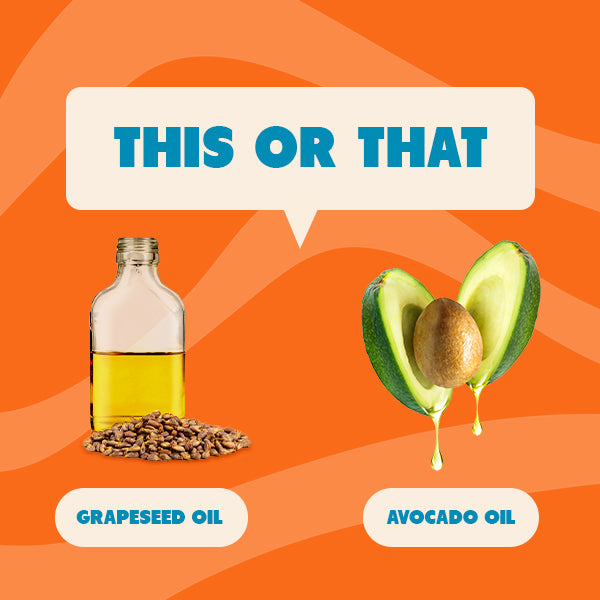
Two oils that frequently spark conversation are grapeseed oil and avocado oil. While they both appear in various recipes and snacks, they are fundamentally different choices. In this guide, we are breaking down the differences between grapeseed oil and avocado oil, looking closely at how they are processed, their cooking properties, and their fatty acid profiles to help you make informed decisions with confidence.
What Is Grapeseed Oil?
Grapeseed oil is extracted from grape seeds, typically collected as winemaking byproducts. Home cooks appreciate its neutral flavor, which allows the natural taste of dishes to shine without interference.
However, grape seeds contain very little oil, requiring intensive industrial processing to extract. This extraction process often involves chemical solvents and high heat, which can strip away natural nutrients [1] and lead to the formation of undesirable compounds [2].
What Is Avocado Oil?
Avocado oil is pressed directly from the green pulp of ripe avocados rather than a seed. Since the pulp is naturally rich in fat, it can be extracted using gentle mechanical pressing methods.
This process helps preserve the oil's natural nutrients. Avocado oil offers a smooth, buttery flavor that brings a delicious, subtle richness to cooking, sautéing, or roasting without overpowering other ingredients.
Key Differences: Grapeseed Oil vs. Avocado Oil
Fatty Acid Composition and Balance
The most significant difference between these two oils lies in their fat profiles. Grapeseed oil consists primarily of polyunsaturated fatty acids (PUFAs), particularly omega-6 fats. While omega-6 fatty acids are essential nutrients, modern diets are often heavily skewed toward them. Some researchers suggest that consuming a high amount of omega-6 fatty acids relative to omega-3s may promote inflammatory pathways in the body [3, 4].
In contrast, avocado oil consists mostly of monounsaturated fatty acids, specifically oleic acid, along with vitamin E [5]. Monounsaturated fats are highly regarded for supporting cardiovascular health markers [6] and helping support gut lining integrity [7].
Cooking Stability and Oxidation
How an oil behaves when heated is crucial for both kitchen performance and wellness. Because polyunsaturated fats contain multiple double bonds, they are chemically less stable. Under high cooking temperatures, high-PUFA oils like grapeseed oil are more prone to heat-induced oxidation, which can generate free radicals [8, 9].
Avocado oil is exceptionally heat-stable. Thanks to its high monounsaturated fat content, it can withstand cooking temperatures up to 500°F without breaking down or oxidizing, making it an excellent choice for high-heat cooking.
Flavor Profiles and Kitchen Uses
While grapeseed oil's neutral flavor works well when you want the oil to disappear into the background, avocado oil offers a fresh, buttery flavor that enhances dishes without dominating them.
Grapeseed Oil vs. Avocado Oil at a Glance
To help you quickly compare these two options, here is a summary of how they stack up:
- Extraction Source: Grapeseed oil is a byproduct of winemaking extracted from grape seeds, whereas avocado oil is pressed directly from the rich pulp of the fruit.
- Fatty Acid Profile: Grapeseed oil consists primarily of polyunsaturated fats (omega-6), while avocado oil is rich in monounsaturated fats (oleic acid).
- Heat Stability: Avocado oil is exceptionally heat-stable up to 500°F, while high-polyunsaturated grapeseed oil is more chemically sensitive to oxidation under high cooking temperatures.
- Flavor Profile: Grapeseed oil has a neutral flavor, whereas avocado oil delivers a fresh, buttery taste that adds a delicious touch to your dishes.
The Jackson's Choice: Avocado Oil Always
Being intentional about ingredients does not stop with what you pour into your pans. At Jackson's, we are Avocado Oil Always. We choose avocado oil for our kettle-cooking process because of its remarkable heat stability and fresh, buttery taste. You will never find grapeseed oil in our snacks. Instead, our kettle-cooked sweet potato chips are made with real sweet potatoes, avocado oil, and seasoning. This simple combination delivers a superior crunch and a satisfying flavor that lets the taste of real food shine.
If you are interested in exploring more ways to incorporate quality fats into your meals, read our guide on how to substitute avocado oil for vegetable oil in recipes. For more tips on reading labels in the snack aisle, check out our guide to identifying seed oils in everyday foods.
Conclusion: Finding Confidence in Your Kitchen
Choosing between grapeseed oil and avocado oil comes down to understanding their source, high-heat stability, and nutrient profiles. Grapeseed oil is a neutral option, but it is a highly refined seed oil rich in polyunsaturated omega-6 fats. Avocado oil is gently pressed from fruit pulp, exceptionally stable, and rich in monounsaturated fats.
Shopping for wellness does not require a complete overhaul. Simple, mindful adjustments—like cooking with stable monounsaturated fats or choosing snacks made with heroic ingredients—can lead to positive outcomes that fit seamlessly into your busy routine.
Read next: The Full Body Benefits of Avocado Oil

References
- Wiley Online Library: Heavy seed-oil processing can strip away nutrients: https://onlinelibrary.wiley.com/doi/10.1002/lite.201600032
- ScienceDirect: Intensive oil processing can form harmful compounds: https://www.sciencedirect.com/science/article/abs/pii/S0963996923012735?via=ihub
- Open Heart BMJ: High omega-6 intake relative to omega-3 may promote inflammation: https://openheart.bmj.com/content/5/2/e000898
- PMC: High omega-6 intake relative to omega-3 may promote inflammation: https://pmc.ncbi.nlm.nih.gov/articles/PMC8504498/
- PMC: Avocado oil is rich in oleic acid, lutein, and vitamin E: https://pmc.ncbi.nlm.nih.gov/articles/PMC5331551/
- American Heart Association: Avocado oil may support cardiovascular health markers: https://www.heart.org/en/healthy-living/healthy-eating/eat-smart/fats/trans-fat
- ScienceDirect: Monounsaturated fats in avocado oil may support gut barrier integrity: https://www.sciencedirect.com/science/article/pii/S1756464624004961
- PMC: High-PUFA oils are more prone to oxidation during high-heat cooking: https://pmc.ncbi.nlm.nih.gov/articles/PMC6600360/
- PubMed: High-PUFA oils are more prone to oxidation during high-heat cooking: https://pubmed.ncbi.nlm.nih.gov/17384344/


